Cape Town's mega hospital projects to be completed by 2033 despite budget constraints
Advertising
26-08-2024
Read : 888 times
News 24
Source
- Despite a severe cash crunch, the Western Cape Department of Health plans to proceed with the building of new facilities, including three mega projects.
- The department briefed the provincial legislature's Standing Committee on Health about its infrastructure plans for 2024/25.
- The committee learned that three mega projects are in the pipeline: Klipfontein, Belhar, and New Tygerberg Central hospitals.
Despite a severe cash crunch, the Western Cape Department of Health is forging ahead with its plans for a raft of new facilities, including the three mega projects.
The department briefed the provincial legislature's Standing Committee on Health on Friday morning on its infrastructure plans for the 2024/25 financial year. The committee heard that three mega projects are in the pipeline.
These mega projects include Klipfontein, Belhar, and New Tygerberg Central hospitals.
Dr Laura Angeletti-du Toit, the department's chief director of infrastructure and technical management, told MPLs the mega projects are complex.
"We agreed that the time and cost are the two priorities for these mega projects," she said.
Klipfontein Regional Hospital:
In 2013, after the decommissioning of the GF Jooste Hospital in Manenberg, plans were afoot to rebuild the facility. However, due to the demand in the community, there was a need for a regional hospital.
In 2015, the decision was made to build a larger regional hospital for the substructure, and Manenberg was selected as the preferred location.
Angeletti-du Toit said the old GF Jooste site was not big enough to rebuild a regional hospital, so a new site was identified.
"We identified a site that's not as big as we would have liked. It's 7.2 hectares, and it's quite tight but larger than the old GF Jooste site," she said.
The new hospital will service Athlone, Gugulethu, Hanover Park, Manenberg, Mitchells Plain, and Philippi. Construction will be carried out in three phases, and the site will be completed in 2033.
Belhar Regional Hospital:
As part of the department's efforts to unbundle Tygerberg Hospital into two facilities, the Belhar Regional Hospital is among those facilities.
The Belhar Regional Hospital will service the Tygerberg sub-structure, the Khayelitsha and eastern sub-structure, and the Stellenbosch sub-district.
Angeletti-du Toit said there was a need for a regional hospital to serve the metro's eastern communities.
She said:
Residents have to travel far for services, so we identified this as a need. This is linked to the decommissioning of the Tygerberg facility so that we can separate the central and regional hospitals.
This is expected to be completed in 2033.
New Tygerberg Central Hospital:
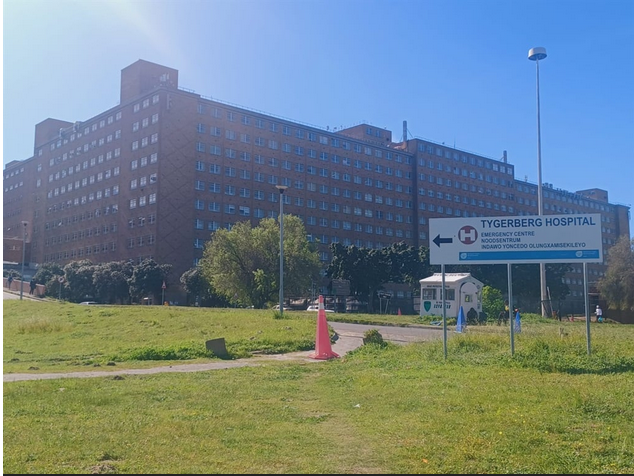
In 2009, the department decided to redevelop Tygerberg Hospital.
The decision was supported by a 2005 report by the Council for Scientific and Industrial Research (CSIR), which indicated that the hospital is nearing the end of its use and economic life and is no longer suitable for delivering modern healthcare standards.
The department told the committee that the aim is to keep the current building functional until the new building is commissioned and the old building is repurposed.
The cost of the new building will be R11 billion.
"We are trying to keep the hospital going from a service point of view. The new hospital will be a similar size to Groote Schuur Hospital," Angeletti-du Toit said.
She told the committee they hope to start construction between 2028 and 2032.
MPL Memory Booysen, chairperson of the committee, said: "Funding cuts from the national government also remain a threat. The Western Cape has persistently been short-changed in recent years due to the national government's failure to adequately update the provincial equitable share formula to reflect the Western Cape's rapidly expanding population.
"In effect, this means that the Western Cape receives a vastly lower budget than it should. Sadly, until this issue is resolved, frontline service departments such as health and wellness are left to do more and more with less and less," he said.
Recent News
Here are recent news articles from the Building and Construction Industry.
Have you signed up for your free copy yet?