Tjeka Empowers Toekomsrus Youth Brick by Brick
Advertising
14-01-2026
Read : 151 times
The Content Engine
Source
Tjeka Training Matters has already helped the Department of Human Settlements (DHS) equip many unemployed adults from poorer communities with the skills they need to find gainful employment in the building industry. This programme will continue under the DHS’ Youth Build Project this year, with Tjeka already engaged to facilitate the training.
At the end of 2025, more than 50 youth from the Toekomsrus community completed a Construction Education and Training Authority (CETA)-registered bricklaying course.
The group is the latest to have successfully completed the programme. Tjeka’s high-impact bricklaying course aligns with the South African Qualifications Authority’s (SAQA) requirements.
Holders of this SAQA qualification have received both quality theoretical and practical training in bricklaying. This is complemented by other unit standards that impart the knowledge required to function at optimal levels on a modern building project.
These include fundamental numeracy; reading and interpreting construction drawings; and maintaining building tools, equipment, and materials.
Most notably, many young women have already completed Tjeka building courses, which are being implemented by the National Home Builders Registration Council (NHBRC).
They are determined to break the stigma attached to this trade—a stigma that can be traced back about 9 000 years to the dawn of ancient civilisations—that has prevented more women from pursuing careers as bricklayers. This is despite a severe shortage of this critical skill in the country.
While many South Africans purport to be bricklayers, they have not undergone any formal industry training, negatively impacting building projects.
Given that it is physically demanding, bricklaying has long been considered a male-centric career, discouraging women from pursuing roles in the sector.
DHS, NHBRC, and Tjeka are breaking this mindset.
Many women who completed the programme discovered a newfound passion for construction during their training. Initially, many joined as unemployed young adults simply because they struggled to find other work, viewing the Youth Build Project as a rare glimmer of hope. At the time, most were certain they did not want to pursue bricklaying as a long-term career.
Yet, they quickly realised the unique strengths they brought to the profession as women—such as meticulous precision and innovative problem-solving. This shift in perspective transformed their outlook, turning a temporary solution into a rewarding and viable career path.
Women such as Lee-Anne Visagie, Bronwyn Solomon, and Kaleshai Welkom, who are in their early 20s, aspire to eventually start their own building businesses once they have gained sufficient work experience.
They note that while the job is physically demanding, female bodies adapt quickly to the labour of lifting bricks and mortar as fitness levels increase.
Encouragingly, the bricklaying trade is also attracting young men, such as Duaniel Saal, Kylin Nero and Bradley Williams. They say that knowing that something they built with their hands would last for generations provides immense job satisfaction – a daily sense of achievement that desk-based jobs often lack. They worked side by side Visagie, Solomon and Welkom, keeping one another motivated to complete the course with flying colours.
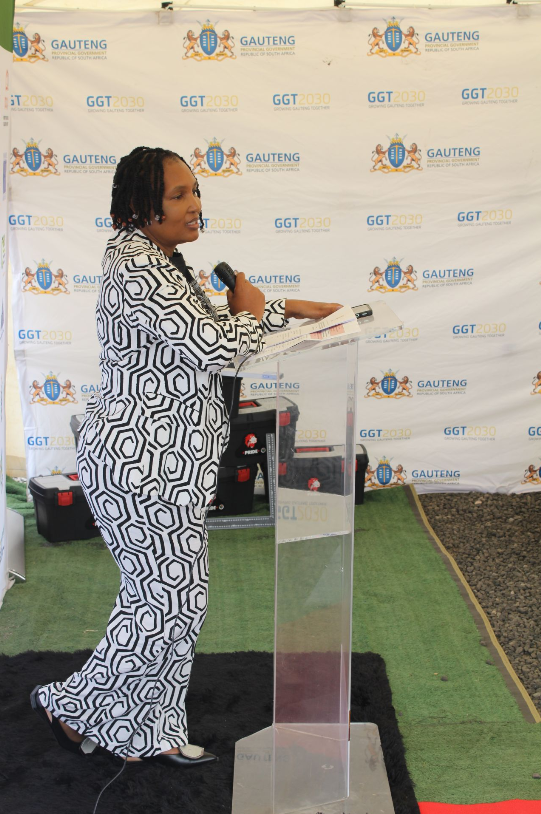
At a graduation ceremony held at Tjeka’s Aureus’ state-of-the-art training facility where the theoretical and practical training was facilitated, Visagie, speaking on behalf of the 51 graduates, lauded Tjeka for the high quality of training that was offered.
The event was attended by Thembi Simelane, Honourable Minister of Human Settlements; Tasneem Motara, Member of the Executive Council; and Tamlyn Bouwer, Chief Executive Officer of the National Home Builders Registration Council (NHBRC).
Simelane praised the graduates for their exceptional performance, rated at 95% by final competency assessments.
“Brickwork is often the first visible indicator of a home’s structural integrity,” she said, noting the exceptionally high quality of skills transferred. “Your training is accredited at National Qualifications Framework Level 3, ensuring that your skills are recognised, respected, and portable within South Africa and beyond.”
Simelane witnessed firsthand the high proficiency levels of the graduates when she visited the Mega West Catalytic Development, where they completed their practical training.
Located within the West Rand District Municipality, this development is a collaborative effort between the Gauteng Department of Human Settlement and the Housing Development Agency, as well as the private sector.
Motara noted that the future of housing and infrastructure depended on skilled, ethical, and purpose-driven youth, such as the 51 young adults who worked hard to complete their training. “Notably, there were no dropouts from the initial enrolment in June, with all of the students successfully completing the programmes,” she said.
Motara also encouraged graduates under the age of 35 to continue with a six-month programme supported by the National Youth Development Agency to further use their newfound skills in human settlement delivery.
Bouwer said that the construction industry was being strengthened by the entry of new, skilled professionals. “To every graduate, the industry is better with you in it. Now go and build,” she said.
Bouwer emphasised that bricklaying is a vital trade. “Watching new entrepreneurs rise within the sector is the greatest reward for the council’s training efforts,” she said, while reminding the graduates that owner-builders had to register and enrol with the NHBRC in line with new legislative definitions under the Housing Consumers Protection Act.
Frans Toua, Chief Executive Officer of Tjeka, said that the private Technical and Vocational Education and Training college was proud of the part that it was playing in helping government to develop the skills needed to improve social service delivery to citizens, while focusing on attracting and developing the new talent needed to take the industry forward.
“Exactly 60 days ago, a group of energetic and outspoken young grown-ups walked through Aureus’ gates, and today all of them have received their certificates. Your achievements speak to your commitment, discipline, and determination to build a better future for yourselves,” said Frans Toua, Chief Executive Officer of Tjeka.
He encouraged the learners to carry the same energy forward. “If you stay focused and motivated, you will succeed,” Toua said.
For more information please contact:
David Poggiolini
Debbie Poggiollini
Recent News
Here are recent news articles from the Building and Construction Industry.
Have you signed up for your free copy yet?