Property owners warn Durban of Berea's decay

Advertising
28-11-2013
Read : 293 times
IOL
Source
The eThekwini municipality was warned of the effect of urban creep, illegal businesses and buildings in a plan they adopted last year for Durban's once-exclusive Berea.
Despite this, residents are at their wits' end, saying the city is doing nothing to stop the blatant defiance of bylaws in the area.
The 62-page document said that for 10 years illegal office buildings, businesses and construction had created a 'domino effect' which was now adversely impacting on investment and the architectural integrity of one of Durban's oldest areas. This was from Davenport Centre in the south to Windermere Centre in the north.
The plan lines up with eThekwini's 2013/14 Spatial Development Framework report where areas like Umhlanga Ridge, the KwaMashu town centre, La Lucia Office Park, River Horse Valley, the emerging Cornubia industrial area and the Umhlanga Promenade are mentioned as key areas that, through 'densification', can drive up the metro's rates income and attract investment and tourism income.
Both the plans agreed that the environmental integrity of areas like the Berea must be carefully considered before any development was allowed so they remain 'quality' living areas.
While the Berea report said there were opportunities to create more offices and living spaces, it warned that development around its shopping malls - Windermere, Overport City, Musgrave and Davenport - must be consolidated and restricted from spreading into adjoining neighbourhoods.
The report also urged that growing industrial activity along Umbilo and Umgeni roads must not be allowed to degrade the adjoining residential areas of Morningside and Glenwood.
The Berea, Glenwood, Umbilo and Morningside are considered by the city as 'core extensions' of the inner city centre and where less dense housing, between three and 10 dwellings per hectare, could be consolidated in a 'densification' strategy to curb urban sprawl, which the reports say is putting unsustainable pressure on natural resources.
Iyer Urban Design Studio - which has offices in Durban and Gauteng - was commissioned by the city's land use management unit to write the Berea report.
It warned the city of indiscriminate destruction of trees, flora and fauna - another major gripe from the residents - which, the urban planners said, sets the area apart.
'The Berea is just not merely another suburb... it as a place of richness and complexity,' they said.
While the Berea plan highlighted the ageing storm water and sewerage system as a challenge, it said natural growth and progression of the area, while reflecting the colonial, Cape Dutch, Victorian, Edwardian and Art Deco designs, was possible.
The comprehensive document, which spokeswoman for the city, Sohana Singh, confirmed had been adopted, also offered various planning solutions which, according to residents, have not been seen 'on the ground'.
In an interview in The Mercury in September, head of the land use unit, Lekha Allopi, blamed lawless construction and illegal businesses on the Berea on too few law enforcers, clogged courts and red tape.
Former urban regeneration and development expert for the inner city, Richard Dobson, who is one of the leaders of the newly formed Save our Berea forum, slammed the city for allowing indiscriminate construction and business operations to flourish while saying that unless something was done soon, established businesses and residents would disinvest.
'They are riding roughshod over existing businesses, some of whom have been in place for many years. They haven't nurtured what's here. What do you do if some clown moves in next door and builds something that undermines the existing business?' RESIDENTS of Durban's upmarket Berea area have resolved to tackle illegal businesses, unplanned buildings and escalating crime and grime in the suburb, saying they are fed up with the city's slow response to their concerns.
At a meeting this week about 400 residents listed their concerns as: a drastic fall in general safety; an increase in the number of beggars and vagrants; squatters in abandoned buildings; and brothels in residential homes. They said they were frustrated at not being able to get the police or the council to act on their complaints.
Yesterday The Mercury went on a snap photographic tour to see how the once-leafy suburb has changed in recent years. Massive building operations are under way across the suburb with some blocks of flats being built where period houses once stood.
The architecture of many of the new buildings is not in keeping with the residential 'integrity' of the area.
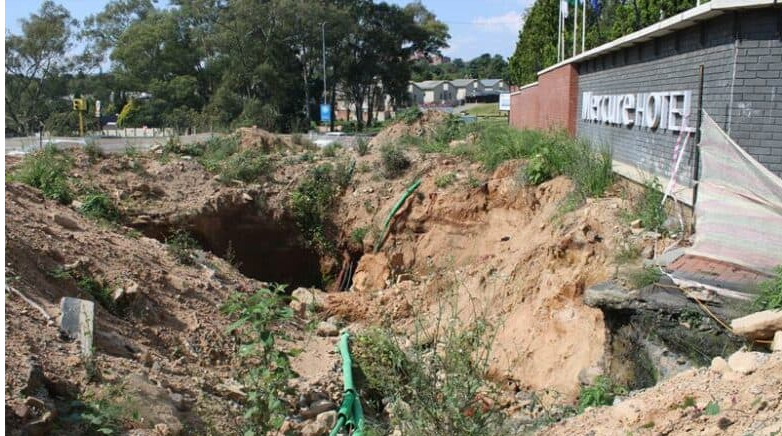
While roads were recently re-surfaced, many pavements have not been restored after maintenance work, leaving them uneven and in some cases covered with gravel and dirt.
Generally the suburb was clean; however, in some parts, litter was piled up in drains and abandoned buildings.
Recent News
Here are recent news articles from the Building and Construction Industry.
Have you signed up for your free copy yet?