Passive, Permanent Protection Beats Coatings, Crystallines and Inhibitors
Advertising
05-02-2026
Read : 57 times
The Content Engine
Source
Spray-Lock Concrete Protection’s innovative SCP technology successfully addresses all of the known limitations of conventional concrete protection treatments.
“SCP represents a groundbreaking approach to concrete protection,” says Sheldon White, National Sales Manager of Spraylock Africa.
“Unlike conventional treatments such as silicates, silanes, oxysilanes, crystalline additives, surface hardeners, corrosion inhibitors, coatings, membranes, or curing compounds, SCP creates a permanent, integral improvement to the concrete matrix.”
White explains that the spray-applied, post-placement colloidal silica solution penetrates deeply into the concrete's capillaries. Laboratory tests demonstrate that SCP technology achieves penetration depths of at least 38 mm in a 100 mm-thick slab.
It then triggers an internal chemical reaction with available calcium hydroxide to form additional Calcium-Silicate-Hydrate (CSH), the primary binding phase in concrete. This process fills and densifies the pore structure from within.
“This is a permanent, one-time application that has yet to fail in the more than 30 years that it has been specified by global asset owners and operators, engineers and architects, as well as contractors,” he states.
By becoming part of the concrete itself, SCP delivers multi-functional benefits. These include waterproofing, permanent moisture control, reduced drying shrinkage, enhanced durability, and resistance to environmental and chemical attack.
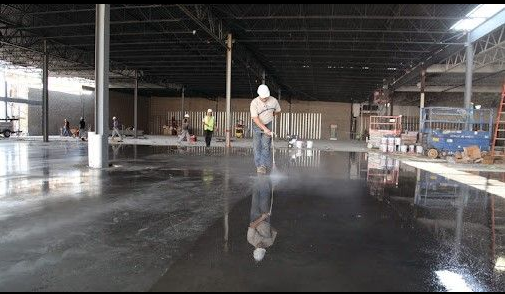
Significant time and cost savings like “pour to floor” in 14 days are also being realised by Spraylock Africa’s clients.
White says that SCP-treated concrete can often be walked on the next day, eliminating the need for water curing, curing membranes, or delays associated with traditional methods. “By replacing multiple single-purpose products, our technology streamlines construction processes for fast-track projects,” he says.
He says that unlike traditional coatings and membranes, SCP does not conceal underlying issues until corrosion advances.
It also does not risk expansion-related cracking – as is the case with crystalline products.
“Meanwhile, surface-applied silicates degrade over time due to carbonation; corrosion inhibitors often fail to reach all embedded reinforcement effectively; and powdered admixtures may not disperse uniformly during batching,” White says.
He says that SCP continues to gain market traction for its innovative, passive, and permanent protection – particularly in applications such as industrial floors, fuel station forecourts, data centres, mining, marine environments, exposed concrete, cold storage, water containment, and structural repairs.
“Spraylock Africa remains committed to delivering our advanced solutions to clients across Africa,” he concludes.
For more information contact:
David Poggiolini
Debbie Poggiolini
debbie@thecontentengine.co.za
Recent News
Here are recent news articles from the Building and Construction Industry.
Have you signed up for your free copy yet?