Missing key upgrades questioned over Garsfontein Road construction
Advertising
29-04-2026
Read : 469 times
The Citizen
Source
Residents say the Garsfontein Road upgrade is missing critical elements, warning without key intersection upgrades, traffic congestion will remain a long-term problem.
Frustration is mounting among residents over the ongoing upgrade of Garsfontein Road, with questions being raised about planning decisions, missing infrastructure components and the long-term impact on traffic flow.
Resident, Stuart Louw, said he was concerned about key commitments linked to the project that have not materialised, despite years of planning and a significant budget allocation.
The Tshwane metro approved a R228-million upgrade project in 2019, aimed at improving traffic flow and addressing problematic intersections along the busy corridor.
Louw said in 2014, an assessment was conducted by the Gauteng Department of Roads and Transport (GDRT), which evaluated traffic volumes and future demand across key intersections.
He explained that the study identified the intersection of Solomon Mahlangu Drive and Garsfontein Road as one of the top 26 intersections requiring future grade separation.
He is now questioning if this upgrade will be made on the new K50 Garsfontein and K69 Road project currently ongoing.
"Why was a cheaper option chosen when it was already determined that grade separation would be required? Without the separation, this upgrade will negatively affect future traffic flow,” Louw said.
He argued that while phased development may be necessary, the exclusion of critical infrastructure, particularly the bridge, risks prolonging congestion and limiting the benefits of the entire road upgrade.
Metro spokesperson Lindela Mashigo said the project forms part of a jointly planned programme between the city and GDRT, guided by a 2014 Memorandum of Agreement, later amended in 2018.
He explained that the upgrade is being implemented in phases to align with available funding while improving safety, capacity and long-term network performance.
“The intersection designs and upgrade scope are based on approved technical studies, including traffic impact assessments and planning reports,” Mashigo said.
According to Mashigo, the project is currently progressing, with physical completion at 46%, time elapsed at just under 48%, and financial progress at about 45%.
Completion is expected by August 2027.
Mashigo clarified that the construction of a new bridge over the Moreleta Spruit was never included in the project scope.
“Major structural interventions such as bridge replacements are typically implemented as separate capital projects due to their scale, cost and environmental approval requirements,” he said.
He added that while the current upgrade aims to improve traffic flow approaching the bridge, the structure itself remains earmarked for potential future upgrades, subject to funding and demand.
Mashigo maintained that the current design is based on detailed traffic modelling, engineering standards and long-term planning principles, and is intended to accommodate current and medium-term demand.
He said traffic studies conducted at the time, in 2014, based on projections up to 2026, indicated that the intersection would operate within acceptable levels of service, meaning a grade-separated solution was not technically required at that stage.
Spokesperson for the MEC of GDRT, Lesiba Mpya, said the department’s rehabilitation projects include dualisation, pavement improvements, vegetation and roadside maintenance, as well as repairs to traffic signs and other road furniture.
“As part of the upgrade package, the department is currently undertaking a 30-month upgrading project of Garsfontein Road (K50) to support the Mooikloof Mega City development,” said Mpya.
The residential and commercial mega-project is a strategic integrated development aimed at providing access to lifestyle services for lower-income groups.
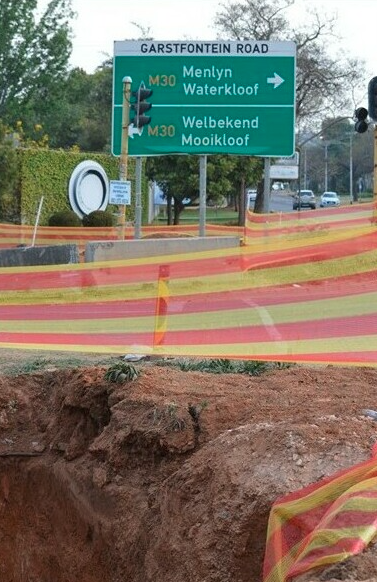
He said roadworks along Garsfontein Road are currently underway, with reconstruction and upgrade work progressing.
“Once completed, the upgrades will result in a divided four-lane road between January Masilela Drive and Loristo Street, including the installation of pedestrian lanes.”
He said, however, the department noted that some sections of the road falling outside the current construction limits will be maintained separately by internal maintenance teams.
Mpya said the upgrades are expected to significantly improve connectivity, increase roadway capacity, and enhance overall road safety.
He added that the contractor has implemented an approved traffic accommodation plan, which is continuously monitored to manage traffic flow during construction.
“Lane restrictions are currently in place at intermittent locations along the route, which is expected to result in slow-moving traffic and delays, particularly during peak periods.”
He urged motorists to approach the construction sites with increased caution.
The department also confirmed its willingness to engage with affected communities to find sustainable solutions to challenges experienced during the construction period. Stakeholder meetings are being held as part of this process.
He said GDRT further noted that no material contractual non-compliance affecting public safety has been recorded on the active section of the project.
Recent News
Here are recent news articles from the Building and Construction Industry.
Have you signed up for your free copy yet?