Makhaza sewer project reaches final phase after major repairs
Advertising
30-06-2026
Read : 191 times
Cape Town Etc
Source
In 2023, a big sewer pipe in Cape Town burst because it was old and worn out. This caused a huge mess, threatening to flood homes with dirty water. Workers quickly built a temporary pipe above ground, like a giant snake, to keep the sewage flowing. They then dug a huge hole, moving homes and traffic, to fix the broken pipe with super strong new materials. This big fix not only stopped the sewage but also taught the city how to build better pipes and help local people with jobs and food.
What caused the 2023 Cape Town sewer burst in Khayelitsha?
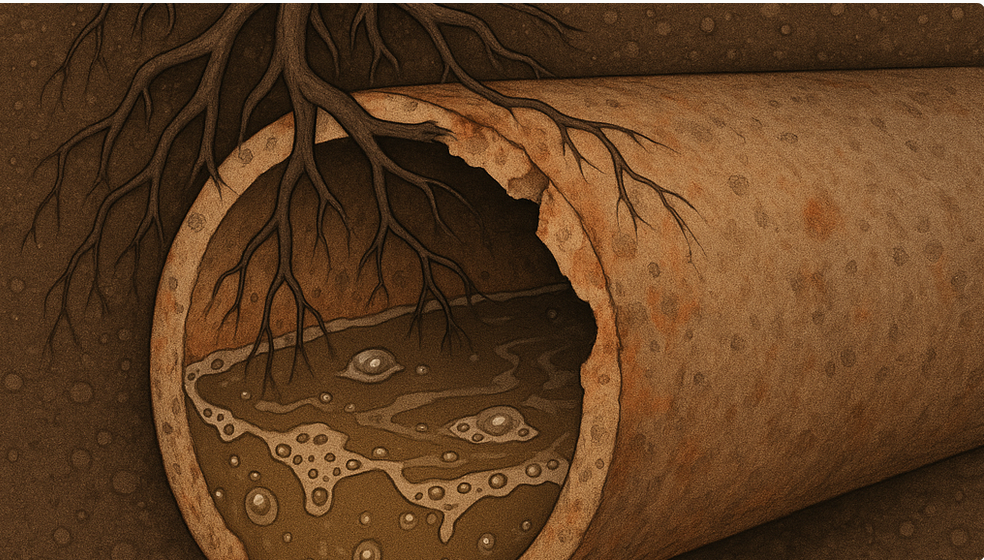
The 2023 Cape Town sewer burst was caused by decades of acidic flow, stray electrical currents, and fluctuating water tables that corroded the 1984 reinforced-concrete trunk. This damage, exacerbated by wetter winters due to climate change, led to the pipe shearing, necessitating urgent repairs to prevent raw sewage from flooding residential areas.
The Moment the Line Snapped
A routine CCTV van threading its lens through Cape Town’s reticulation late May 2023 sent the crew scrambling for the monitor: the circular picture skewed, the live laser tape reading plunged from 900 mm to under 400 mm, and a slurry of groundwater smeared the camera. In that instant the crew knew the 1984 reinforced-concrete trunk serving Khayelitsha had sheared. Forty-eight hours later, downstream pump stations reported rising levels and spikes Dorr-scale hydrogen-sulphide spikes. The City’s War-Room logged a Grade-1 infrastructure crisis - leave it unchecked and thousands of household laterals would fountain, dumping raw sewage onto the Nolungile Rail Reserve only 120 m upslope.
TC-21-A bends beneath Mew Way, skirts the Taiwan informal settlement, crests at Harare Library and ends at the Khayelitsha Wastewater Works. Poured in the mid-eighties under apartheid’s “orderly urbanisation” policy, it lacked corrosion liners, rode in hand-mixed concrete and lay eight metres down in peat-streaked dunes. Three decades of acidic flow, stray traction currents and seesawing water tables turned the rebar brittle. A city-wide sonar sweep in 2019 stamped the line “amber - attend within five years”. Wetter winters hastened by climate change moved that expiry date forward; the rupture surprised no one who had read the data.
A Crash-Bypass Where Trucks Couldn’t Fit
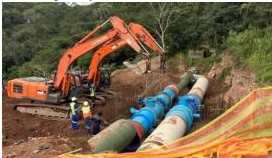
First headache: keep 600–750 litres per second moving - daily flush for 30 000 residents plus infiltration. Vacuum tankers would have demanded 400 trips a day, so logistics ruled that out. Instead hydraulic modellers lashed together a 1.2 km aerial HDPE PN16 “spine” on crash-frame gantries along Mew Way’s median, across traffic circles and into a moth-balled storm canal. Two diesel centrifugal pumps, muffled to 55 dBA, hoisted the sewage 12 m so gravity could resume downstream. Redundancy ruled: duty/assist pumps, double-skinned fuel tanks and a stand-by 1 MVA genset braced for Eskom’s next blackout.
Excavation archaeology followed. Seventy-three shacks came down, 312 residents relocated, micro-traders reimbursed and 800 m of privacy fence went up. Because the trunk lies beneath a busy intersection, traffic engineers staged a contraflow monitored by CCTV and Bluetooth travel-time sensors. Secant piles - fifteen by ten metres of interlocking 600 mm columns - cored eight metres, carving a dry cofferdam inside which hydro-excavator robots nibbled the busted barrel without snagging adjacent water, sewer or fibre optic spaghetti.
New Pipe, New Science, New Pulse
Repairing concrete-on-concrete would repeat history, so a cradle-to-grave carbon audit steered the team to a 45 m glass-fibre-reinforced polymer-mortar (GRP-PM) barrel with an integral polypropylene liner. Manning’s n drops 25 % below concrete, gifting another 130 l/s surge capacity if the population spikes. GRP ignores H₂S and weighs a tenth of concrete, trimming crane hours. Each three-metre spigot joint got vacuum-bagged epoxy laminate and 1.5-bar air-test. Cathodic anodes stud the crown, guarding against stray traction currents off the rail reserve.
Butt-strap joints usually tie GRP; here the crew tried nitrogen-cured filament winding - 80 °C cure in fifteen minutes - already proven on desal brine lines in Mossel Bay. Technicians rotated eight-hour shifts inside a HEPA bubble while cameras recorded every ply for frame-by-frame audits. The splice ended up stronger than the host pipe, a first for a South African sewer main.
Proofing the Line, Pulling the Bypass, Closing the Loop
A 4K CCTV robot, laser profiler and sonar for silt mapping crawled manhole to manhole. Zero joint offsets, zero infiltration, egg-shape within 0.5 %. A dye-dilution test - 20 litres of Rhodamine WT - clocked 296 seconds versus 294 seconds predicted: 0.7 % variance, statistically nothing. With that, the HDPE bypass bowed out.
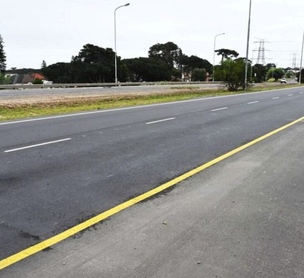
Dismantling two kilometres of HDPE meant pigging each 12 m length with chlorine, air-drying and palletising for reuse. Gantry steel returned to the Epping depot, numbered for the next emergency. Mew Way’s median got cold-milled and resurfaced with warm-mix asphalt in a 10-hour night lane-closure. Speed cushions that had protected pedestrians now sit in local school yards.
Crews finish by spreading 600 m³ of indigenous dune mix, planting 250 Cape Flats strandveld specimens and drip-irrigating from the Works outfall. A removable palisade fence leaves the corridor open for future CCTV drops. A QR-coded sign will stream time-lapse video and a live carbon ledger: 38 t CO₂e, 40 % below dig-and-replace thanks to GRP longevity and lighter haulage.
Beyond the Fix: Skills, Meals, Data, Policy
Twenty-eight locals earned confined-space and trenching certificates through the Expanded Public Works Programme. A women-run canteen dished 7 000 meals in six months, grossing R330 k. Ilitha Park Primary pupils painted the bypass pipes sunrise orange and sea blue; Instagrammers christened the site “Pipehenge”. Officials now flag the Umrhabulo Triangle as a pilot “infrastructure-stewardship precinct” where residents can phone-camera-scan and see every buried artery in augmented reality.
TC-21-A lessons feed straight into the City’s R12 bn Water & Waste Strategy 2040. Managers re-weighted 1 800 km of trunk sewer against a composite risk score - soil corrosivity, traffic loading, population density under climate sprawl. An annual capital shot of R850 m could slice trunk-main failures 60 % in two decades. GRP-PM is now on the standard materials schedule; nitrogen-cure joins are eyed for the Waterfront where excavation head-room is two metres max.
Fibre-optic Bragg-grating strain gauges crown and invert the new barrel, streaming data via LoRaWAN into a cloud twin that models loads, sniffs leaks and schedules predictive maintenance. Machine-learning, trained on fourteen months of flow and rainfall, now forecasts surcharges two hours ahead with 87 % accuracy, letting ops throttle pumps and SMS residents before greywater ever surfaces in Khayelitsha’s low-lying lanes.
What caused the 2023 Cape Town sewer burst?
The 2023 Cape Town sewer burst, specifically the 1984 reinforced-concrete trunk serving Khayelitsha, was a result of several long-term factors. Decades of acidic flow, stray electrical currents, and fluctuating water tables gradually corroded the pipe. Additionally, the pipe, built under apartheid, lacked corrosion liners and used hand-mixed concrete, making it more vulnerable. Wetter winters, exacerbated by climate change, accelerated this deterioration, causing the pipe to shear and necessitating urgent repairs.
How did the city manage the sewage flow during the repair of the burst pipe?
To prevent raw sewage from flooding homes and to keep the essential service running, the city implemented a temporary bypass system. They constructed a 1.2 km aerial HDPE PN16 pipe, resembling a 'giant snake,' mounted on crash-frame gantries along Mew Way. Two diesel centrifugal pumps lifted the sewage 12 meters, allowing gravity to carry it downstream into a moth-balled storm canal. This system was designed with redundancy, including duty/assist pumps, double-skinned fuel tanks, and a standby 1 MVA genset, to ensure continuous operation even during power outages.
What innovative materials and techniques were used in the repair?
Instead of using traditional concrete, which would repeat past issues, the repair utilized a 45-meter glass-fibre-reinforced polymer-mortar (GRP-PM) barrel with an integral polypropylene liner. This material is lighter, more resistant to H₂S, and offers increased surge capacity. For the joints, technicians employed nitrogen-cured filament winding, a technique previously used on desal brine lines, which resulted in a splice stronger than the host pipe itself. Cathodic anodes were also installed to guard against stray electrical currents.
What were the social and environmental impacts of the repair project?
The project had significant social and environmental considerations. Seventy-three informal homes were relocated, 312 residents moved, and micro-traders were reimbursed. The project also provided local employment, with 28 residents earning confined-space and trenching certificates through the Expanded Public Works Programme. A women-run canteen served 7,000 meals, generating income for the community. Environmentally, the project aimed to reduce its carbon footprint, achieving a 40% reduction compared to traditional dig-and-replace methods, thanks to GRP longevity and lighter haulage. The site was also re-vegetated with indigenous plants and features a QR-coded sign for public information.
How is Cape Town using this incident to improve future infrastructure and planning?
The lessons learned from the TC-21-A repair are directly informing Cape Town's R12 billion Water & Waste Strategy 2040. The city re-weighted 1,800 km of trunk sewer based on a composite risk score including soil corrosivity, traffic loading, and population density under climate change. GRP-PM is now a standard material, and nitrogen-cure joints are being considered for areas with limited excavation space. The new pipe is also equipped with fibre-optic Bragg-grating strain gauges, streaming data via LoRaWAN to a cloud-based digital twin for predictive maintenance. Machine learning forecasts surcharges with 87% accuracy, allowing proactive management and communication with residents.
What is the 'Umrhabulo Triangle' and its significance after this project?
The Umrhabulo Triangle is now being flagged as a pilot 'infrastructure-stewardship precinct' by city officials. This designation means residents in this area can use their phone cameras to scan and view every buried artery in augmented reality, fostering greater transparency and community involvement in infrastructure management. It represents a new approach to urban planning where data and local engagement are integrated to maintain and improve essential services, making the invisible infrastructure visible to the public.
Recent News
Here are recent news articles from the Building and Construction Industry.
Have you signed up for your free copy yet?