Huguenot Tunnel upgrade set for R4.5bn expansion
Advertising
10-03-2026
Read : 328 times
Cape Business News
Source
AFRICA’s longest road tunnel is about to get significantly bigger — and safer.
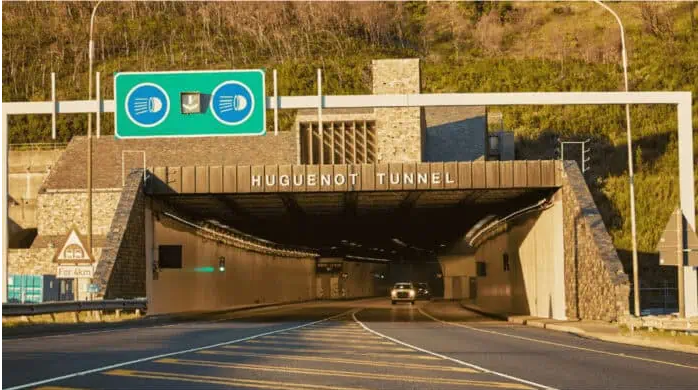
The South African National Roads Agency (SANRAL) has confirmed that the Huguenot Tunnel, the 3.9km toll tunnel linking Paarl and Worcester on the N1 national road, is heading into a multi-year upgrade programme valued at approximately R4.5 billion. The tender for the project is currently being advertised.
The upgrade centres on commissioning a second tunnel bore that has been sitting dormant since the 1980s. When the south bore was constructed and opened in March 1988, a parallel north bore was excavated simultaneously — but never fully fitted out or opened to traffic. It has since served as an emergency escape route. That changes now.
“The commissioning of the north bore will include the installation of a concrete lining, road surface, ventilation, lighting, and modern tunnel management systems,” Luphelo Ngalo, SANRAL spokesperson for the Western Cape Province told Cape Business News. “Once operational, traffic will be diverted to the north bore while the existing south bore is upgraded to the same international standards.”
Upon completion, expected after a total construction period of approximately five years, the Huguenot Tunnel will operate as a twin-bore facility carrying two lanes of traffic in each direction, a significant step up from its current single-bore, bidirectional configuration.
A corridor under pressure
The scale of the upgrade reflects the tunnel’s critical role in South Africa’s freight and logistics network. The tunnel carries approximately 13 000 to 14 000 vehicles per day on average, spiking to around 25 000 during peak holiday periods.
According to SANRAL, heavy vehicles account for roughly 2 700 of those daily crossings, and more than 5 million vehicles passed through in the past year alone, bringing the cumulative total to over 132 million since opening.
The alternative, the Du Toitskloof Mountain Pass, is barely used by comparison. Only about 8% of corridor traffic opts for the pass; the remaining 92% use the tunnel. That dominance underscores how little redundancy exists on this route, and why upgrading the ageing south bore while keeping traffic moving has required a carefully sequenced approach.
Safety imperatives driving the project
SANRAL has cited the European Directive on Road Tunnel Safety (EU/2004/54/EC, Clause 2.1.2), which requires that when a 15-year traffic forecast exceeds 10 000 vehicles per day per lane, a twin-tube tunnel with unidirectional traffic flow becomes mandatory. The Huguenot Tunnel crossed that threshold some time ago.
SANRAL CEO Reginald Demana said that the south bore’s electrical and mechanical systems, built in the 1980s, have neared their end-of-life limits and require a significant safety upgrade – particularly around electricity supply and ventilation – work that can only be completed once all traffic has been shifted to the north bore.
The scope of works on the north bore will include a concrete lining, continuously reinforced two-lane pavement with drainage and services, electrical, ventilation and fire-fighting systems, and upgrades to the highway on either side – including the design of a new Elands River Bridge and the widening of the existing Molenaars River Bridge.
South bore upgrade works will address moisture ingress, structural integrity, and the rehabilitation of fire-damaged sections.
Fire capacity will also be substantially enhanced. The upgrade will improve the tunnel’s resistance to fire by upgrading its load capacity from 30MW to 100MW, and will introduce new ventilation technology for both single and twin-bore configurations, along with fixed fire-fighting systems in both bores.
Project oversight
Consulting engineering firm SMEC South Africa was appointed by SANRAL in 2021 to oversee design, procurement, and construction supervision for the project – a firm with historical ties to the tunnel, having provided structural design and geotechnical services during its original construction in the early 1980s. The design and procurement phase is set to span 15 months, with construction planned over 55 months.
With the tender now under evaluation and construction expected to commence within the coming months, the upgrade represents one of the most significant road infrastructure investments in the Western Cape in decades, and a long-overdue modernisation of a tunnel that has quietly underpinned the Cape’s economy for nearly four decades.
Recent News
Here are recent news articles from the Building and Construction Industry.
Have you signed up for your free copy yet?