Court blocks building along Cape Town’s Diep River floodplain
Advertising
25-03-2026
Read : 128 times
Ground Up
Source
The municipality says this is not an eviction, but residents of Dunoon informal settlements are worried
- The City of Cape Town has obtained a court order preventing further construction of houses on the Diep River floodplain near Dunoon.
- The City says this is not an eviction, but a move to stop unsafe construction.
- More than a thousand families have signed a petition in protest.
Families living along the Diep River have signed a petition in protest of a court order obtained by the City of Cape Town to stop construction on the floodplain. According to a community leader, 1,000 families have signed.
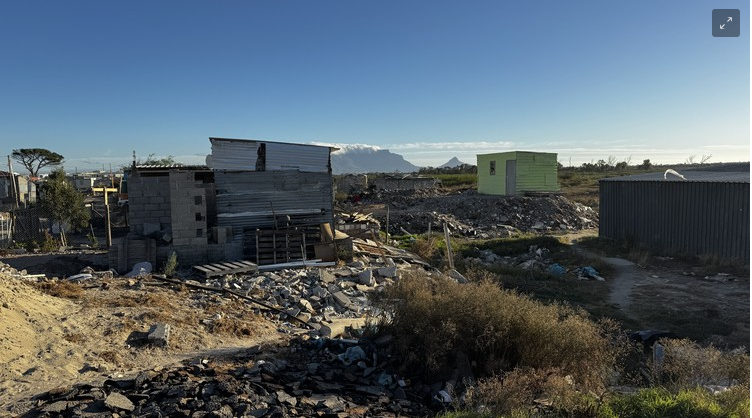
Residents of Dunoon’s Zwezwe and Eluxolweni informal settlements found legal notices stuck to their homes on Thursday, 19 March, warning against further construction.
The draft order, stamped by the Western Cape High Court and dated 3 March, directs that construction of permanent and semi-permanent structures on erf 3844 along Malibongwe Drive cease.
Many residents took the notice to be an eviction. But in response to GroundUp’s questions, municipal spokesperson Luthando Tyhalibongo said it was not an eviction but is meant to stop unsafe construction along the riverbank.
“The legal basis was the need to prevent unlawful and hazardous construction on the riverbank, which poses risks to public safety, health, and the environment,” said Tyhalibongo.
At the Eluxolweni settlement on Sunday, community leader Makhosi Manzi said more than 1,000 families had signed a petition opposing the notice.
Manzi said residents wanted clarity on the land identified in the court document, including where erf 3844 begins and ends.
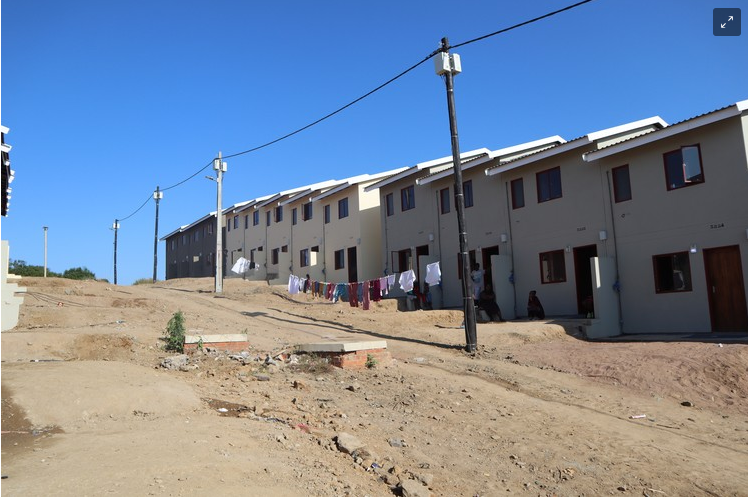
Noluthando Zazini, a security guard and mother of two, has built a two-bedroom house using bricks and cement on the floodplain at Eluxolweni. She shared the home, with an open-plan lounge and kitchen, with her sister.
Zazini says she used R70,000 in savings accumulated over 12 months. She is now building a brick boundary wall.
She says she used to live in a three-room shack on the plot, which she purchased for R7,000 in 2021. She began building her brick house in 2025 and completed it early this year. But there are already large cracks above the foundations and around the windows.
She says building her own home brought her a sense of relief after she had waited 14 years for a housing subsidy. “I used my last money to build a brick house, money I saved for a year. If they demolish it, what will they provide? Will they pay expenses? What will happen?” she asked.
Mfaniseni Mhlabopalele was fined R3,000 on Human Rights Day over unlawful occupation. He now faces a Strand court date but says he cannot afford to get there.
In the Zwezwe informal settlement, Mfaniseni Mhlabopalele, said on Human Rights Day law enforcement officers issued him with a R3,000 fine for unlawful occupation of his shack. But, he said, he had built it three months ago, well before the current court order.
The written notice directs him to appear at the Cape Town Municipal Court on 1 July. “They asked me why I stay here. I said I am unemployed and erected the shack three months ago,” said Mhlabopalele. “I am depressed and shocked at the fine.”
“I don’t even have money to go to court.”
His neighbour Lwazi Mtyeku confirmed that Mhlabopalele had been living in the shack for three months. He believes the fine was unjustified. “Worse, it was on Human Rights Day. They treated him so badly,” said Mtyeku.
Community leader Nandipha Matiwane said that on the same day, law enforcement officers tore down a shack that was being repaired ahead of winter.
Asked how many households were affected by the court order, Tyhalibongo said no assessment had been conducted. He said the order related to preventing further construction, not to displace existing households.
He said the City is ensuring compliance with constitutional protections by avoiding unlawful eviction. He said the interdict is narrowly focused on halting unsafe construction, with the aim of preventing homelessness rather than causing it.
“The City will monitor enforcement of the interdict to ensure it is implemented lawfully, peacefully and without excessive force,” he said.
Recent News
Here are recent news articles from the Building and Construction Industry.
Have you signed up for your free copy yet?